
SEO for Service Based Businesses: The Proven Tactics That Bring in Leads in 2026

Summary of this ArticleKnow what's in this article
SEO for a service business works when buyers already search for what you do, the rankings are within reach, and one qualified lead can repay the cost. Local trades win through map visibility, reviews and location pages, while high ticket firms win through commercial pages, expertise and proof. Start with your buying journey, test the economics, build the pages those buyers need, and measure qualified leads through to revenue rather than traffic.
Smartly summarized from full article, need to know more Talk to a growth expert at GenzPro
SEO for service based businesses should help the right prospects find you, trust you, and take the next step. Yet most advice treats every service company like a local plumber, and tells you to update a Google Business Profile, collect reviews, and build city pages. That can work brilliantly for a trades business, but it is nowhere near enough for a consultancy, law firm, interior studio, or other high-value provider with a longer buying process. At GenzPro Marketing we build SEO around how each of those businesses actually wins customers. As an ai seo service in dubai, we also plan for how buyers now search inside AI tools, not only Google.
The honest answer starts with your business model. Local operators and professional firms compete in different search results, sell through different journeys, and need different pages. This article helps global service-business owners identify their model and understand the economics. It then shows which work is most likely to create qualified leads.
Continue reading before you copy another generic SEO checklist.
SEO for Service-Based Businesses

SEO works when buyers search for your service on Google or AI engines (like ChatGPT, Claude, Gemini), the target results are attainable, and a qualified lead can repay the investment. Local trades usually need map visibility, reviews, and location pages. High-ticket firms need authoritative commercial pages, expertise, and proof. Some need both.
SEO cannot create demand or rescue a weak offer, slow follow-up, or an unconvincing website. Treat it as a measurable acquisition channel, not a promise of free traffic.
What Is SEO for a Service-Based Business?

For a service-business owner, SEO connects pre-purchase searches with the right part of the website. That could be a profile, service page, location page, guide, or case study.
A local electrician’s customer may want urgent help nearby and check availability, reviews, and a phone number. By contrast, a corporate legal buyer may research the problem, possible approaches, specialist experience, fees, and proof over several searches.
Because these journeys differ, a useful strategy connects each search to the right profile or page and then makes the next step clear. Rankings matter, but booked jobs, qualified enquiries, and revenue reveal the commercial value.
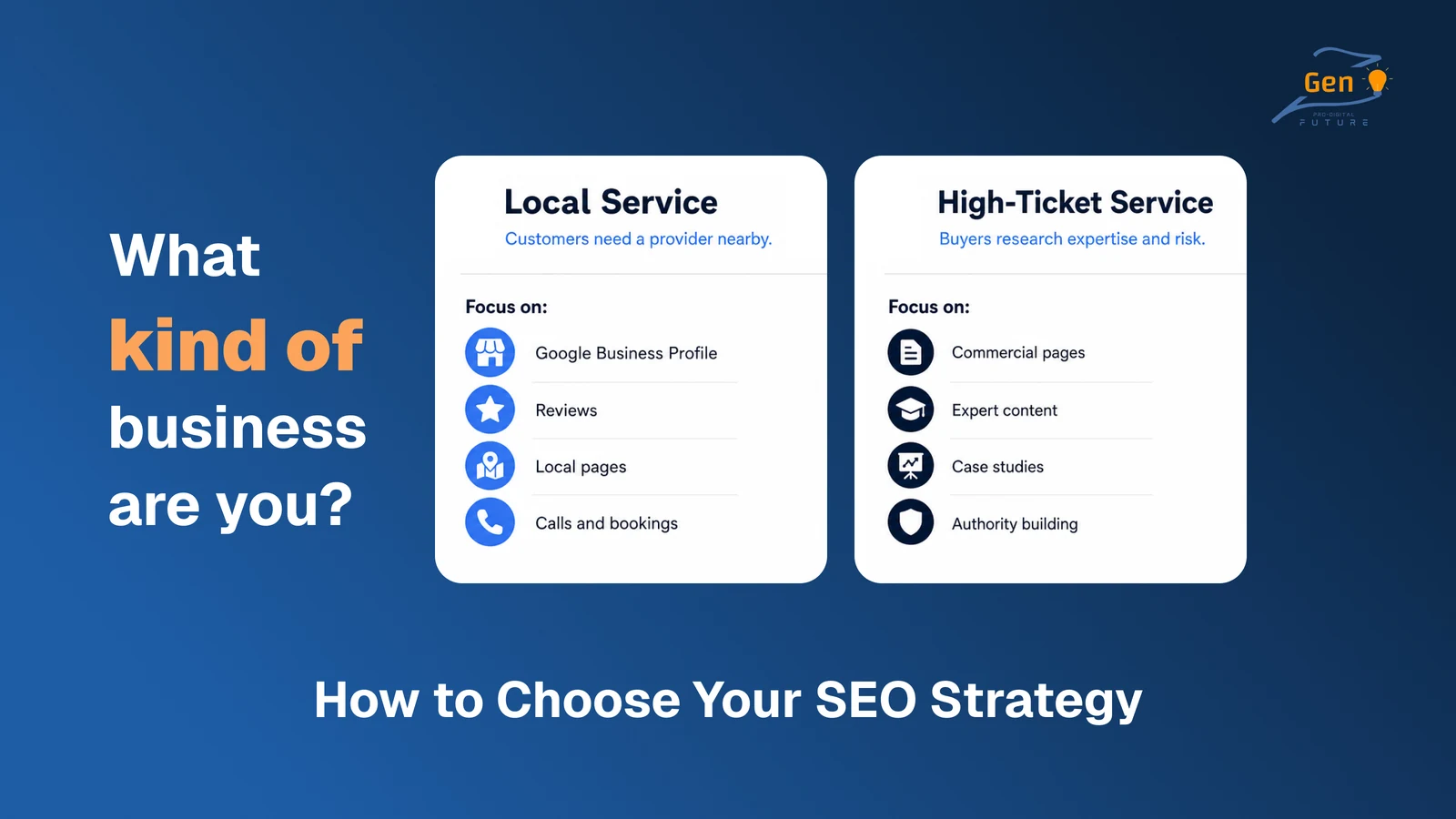
First, Which Kind of Service Business Are You?

Service businesses sit on a spectrum, and these two questions can reveal where yours belongs:
- Does the buyer need a provider nearby?
- How much research and trust does the decision require?
These factors are independent. A plumber may be local with a quick decision, while a remote consultant may need authority without local visibility. Specialist clinics often need both. For that reason, match the approach to how your customers choose.
What Does Local SEO for Service Businesses Look Like?

Plumbers, cleaners, mobile mechanics, and salons often serve a defined area. Local SEO for service businesses should clarify the service, coverage, availability, and why customers should trust the company.
Google says local results mainly depend on relevance, distance, and prominence. See Google’s local ranking guidance.
For a practical starting order:
- Complete the business profile and select accurate categories.
- Confirm the phone number, hours, address, and service areas.
- Build a useful page for each core service.
- Add distinct location pages where genuine demand exists.
- Ask real customers for reviews after the work is complete.
- Track calls, forms, bookings, qualified jobs, and revenue.
For SEO for service area businesses, publish location pages only where you work and can provide useful local detail. Do not clone copy and replace the city name.
What Does SEO for Professional Services Look Like?

Law firms, consultants, design studios, clinics, and B2B providers sell expertise, but prospects check fit, experience, process, and risk. So, SEO for professional services relies on commercial pages and proof.
An SEO strategy for established service businesses should reflect what the firm is known for, supported by relevant industry pages and case evidence.
B2B SEO for service companies may reach several decision-makers, each evaluating the service from a different angle.
For a location-independent consultancy, the map pack may contribute little. Ranking the right service, industry, and buyer-question pages matters more.
Why Does the Same SEO Checklist Fail One of Them?
A plumber can win a call through a nearby listing with strong reviews, but a consultancy buyer needs deeper evidence. At the same time, an emergency service can publish excellent guides and still lose jobs because its profile or coverage is unclear. So, let the buying journey choose the tactics.
How SEO for Service-Based Businesses Becomes Qualified Enquiries

SEO will produce leads in service-based businesses when an effective organic lead generation system is strategized according to demand, visibility, trust, and conversion.
What Is Google Really Ranking?

Think in terms of relevance, authority, and experience.
First, relevance means the page matches the search. General accounting is a weak answer for someone seeking construction bookkeeping.
Authority grows when a credible business earns useful mentions and relevant links. Google’s ranking systems guide includes link analysis among many signals.
Finally, experience appears in original examples, named specialists, clear explanations, and case evidence. Google’s people-first content guidance asks for original value, sourcing, and first-hand expertise.
What Are Commercial Service and Location Pages?

Give a core service its own commercial page when it has distinct intent, problems, proof, and an offer.
A good service page answers practical questions:
- Who needs this service?
- Which problem does it solve?
- What does the service include?
- How does the process work?
- Which factors affect cost or scope?
- Where is the proof behind the claims?
- What should the visitor do next?
An emergency plumbing page might move from availability to problems handled, coverage, response process, licences, local work, reviews, and a call button.
A corporate legal page may move from the problem and suitable client to scope, process, specialist experience, risks, case evidence, and consultation.
Location pages need real demand and distinct details such as local projects, coverage, staff, rules, or testimonials.
What Kind of Content Helps Buyers Make a Decision?
Content that answers pre-sale questions through cost guides, comparisons, process explanations, decision criteria, and case studies can help buyers make a decision.
A narrow guide for a qualified buyer may beat a broad post, but linking it to the service, support claims, and a sensible next step can help.
How Do Reviews, Citations, and Links Move the Needle?
Reviews influence local discovery and customer choice, so ask real clients after delivery and never manufacture feedback.
Meanwhile, citations keep your business details consistent across relevant directories, associations, and local platforms. Poor directories add little value.
Useful links can come from research, expert commentary, partnerships, memberships, or notable projects. Links from unknown sites can add risk and do little for your reputation.
When SEO Is a Good Investment for a Service Business

Run the numbers before approving a plan. The longer answer to is SEO worth it for your business depends on demand, competitive reach, lead quality, and deal economics.
What Is the Cost per Lead from SEO?
Use this basic formula:
Organic cost per qualified lead = total SEO investment divided by qualified organic leads
Include strategy, content, development, tools, PR, and staff time. Count qualified leads, not spam, job applications, or every submission.
Separate setup from ongoing work and compare channels using the same qualified-lead definition.
How Does Deal Value Decide If SEO Pays Off?
Estimate potential value with the full sales funnel:
Search demand × attainable click share × website lead rate × sales close rate × average deal value
Use a range for each input because demand does not guarantee traffic, and a lead does not guarantee a sale.
Build the estimate from your own evidence:
| Input | Where to find it |
|---|---|
| Search demand | Current keyword research for the target market |
| Attainable position | The strength of sites already ranking |
| Click opportunity | Live click-through data and the search-result layout |
| Website lead rate | Analytics and conversion tracking |
| Sales close rate | CRM or sales records |
| Average deal value | Finance or CRM records |
Use low, expected, and strong ranges. If only the strongest case produces a return, the plan carries too much risk.
High-ticket services may recover the investment from fewer clients. Lower-value services need more volume. If a realistic result cannot cover the cost, narrow the market, improve the offer, or choose another channel.
Why Are Page One and the Top Positions So Important?

Visibility without clicks has limited value. Advanced Web Ranking’s live click-through-rate study shows how position and result layout affect the click opportunity.
Compare the depth, brand, links, page quality, and local presence of ranking sites with yours. A narrow phrase within reach may beat a famous keyword you cannot win.
How Long Does SEO Take to Bring Leads?

Well, there isn’t a definite deadline because site history, development, competition, links, and the sales cycle all affect timing.
Set milestones instead. Start by fixing measurement and technical barriers, then improve commercial pages and watch qualified visits, enquiries, and closed revenue. Our guide to the signs your SEO is working shows how to read those early milestones before you reach page one.
If leads are urgent, paid search may cover the wait. This SEO vs Google Ads comparison helps assign each channel a job.
What Do You Need to Start SEO?
You need a defined service, a clear customer, proof, site access, reliable analytics, and someone who can follow up with leads. Subject experts turn generic copy into useful content.
A local operator may need profile management, reviews, pages, and tracking. Professional firms may need positioning, expert interviews, technical SEO, and authority building. If you outsource, choose the right SEO agency by asking how it connects keywords to revenue.
AEO and GEO Make Your Service Business Found in AI Search

For Google Search, AEO and GEO do not require a separate technical system. Google’s guidance for generative AI search says AI Overviews and AI Mode use its existing Search ranking and quality systems. For a practical walkthrough, see this ai seo playbook for local businesses.
How Do AI Overviews and AI Mode Change Lead Flow?
AI Overviews summarise complicated questions and provide supporting links. For deeper research, AI Mode supports exploration, reasoning, and comparisons that might otherwise take several searches.
Both features may use query fan-out. Google runs related searches across subtopics and sources, then identifies pages that support parts of the response. A legal service page could therefore surface for a specific risk or process question inside a broader comparison.
Simple questions may be answered without a website visit. But a complex service purchase still requires scope, experience, evidence, availability, and a consultation process. To measure the impact, track citations and clicks through Google’s Generative AI performance report in Search Console. Then connect those visits with enquiries and revenue in your analytics and CRM.
How Does a Service Business Become Eligible for an AI Citation?

Google says a supporting page must be indexed and eligible to appear in Search with a snippet. No special AI schema, machine-readable AI file, llms.txt file, or artificial content chunking is required.
In practice, keep crawling open, link important pages internally, place key information in readable text, and make structured data match the visible content. Local companies should also keep their Google Business Profile details current.
Meeting those rules does not guarantee a citation. Give Google something specific to retrieve, including named price factors, service limits, process steps, or project evidence. Local experience, author details, and original case findings can add further proof. A rewritten definition that appears on hundreds of sites adds little.
Comparison of SEO for Service Businesses Between Local and High-Ticket Models

The difference comes down to search urgency, location, deal value, and the amount of proof required before contact.
What Does Each Type Search For and Where Do They Win?
Local buyers often search for an immediate service in a place. Professional buyers research costs, methods, risks, suitability, and experience through commercial pages and content.
What Does the SEO Investment and Payback Look Like?
Local trades often need more qualified jobs. High-ticket firms may recover the investment from fewer clients, but revenue can take longer to appear.
Which Content and Signals Matter Most?
Local firms need profile accuracy, reviews, coverage, and useful location pages. Professional firms need commercial pages, expert content, case proof, and relevant authority.
| Factor | Local or trade service business | High-ticket professional service firm |
|---|---|---|
| Examples | Plumber, cleaner, HVAC company, salon | Law firm, interior studio, clinic, consultancy |
| Typical need | Immediate or near-term help | Considered decision with more perceived risk |
| Main search battleground | Google Business Profile, local map pack, service and location pages | Organic authority through commercial pages, industry content, and guides |
| Common search style | Service near me or service in a location | Cost, process, comparison, suitability, and specialist questions |
| Deal pattern | Often lower value and more dependent on volume | Often higher value, so fewer suitable clients may repay the work |
| Role of reviews | Strong local trust and choice signal | Important proof alongside expertise and case evidence |
| Sales cycle | Usually shorter | Usually longer and may involve several stakeholders |
| Winning pages | Service pages, useful location pages, project proof | Service pages, industry pages, guides, and case studies |
| Local visibility | Usually central | Supporting or central, depending on how buyers search |
| Best measurement | Calls, bookings, qualified jobs, and revenue | Qualified enquiries, consultations, pipeline, and revenue |
Some firms sit in both columns. A clinic may need local visibility and deep authority, while a contractor may rank locally but sell through a long tender.
Which SEO Approach Should Your Service Business Choose?

Choose by looking at where customers search, how quickly they buy, and how many closed deals are needed to cover the SEO cost. If you are deciding between DIY SEO and hiring an agency, compare the time it would take you with that cost as well.
Focus on Local and Map-Pack SEO If
- Customers hire a nearby provider.
- Service areas limit where you can work profitably.
- Calls, bookings, or urgent enquiries drive sales.
- Reviews and availability shape the choice.
- Target searches display a local pack.
Start with profile accuracy, categories, reviews, local pages, and conversion tracking. Add content that supports valuable services or customer questions.
Focus on Authority and Organic SEO If
- Buyers research expertise before making contact.
- The deal value supports a longer trust cycle.
- Your service solves a complex problem.
- Several people influence the decision.
- Service pages and guides dominate the target searches.
Start with positioning, search intent, commercial pages, expert content, case proof, technical quality, and authority. Prioritise strong pages over interchangeable articles.
Why Some Service Businesses Should Do Both
A clinic may need local discovery and detailed treatment pages. An architecture studio may need city visibility while clients review its work.
Local SEO creates proximity and quick trust. Organic authority answers harder questions. Measure both against qualified enquiries.
Choose the SEO Model Your Lead Economics Can Support
Start with the buying journey, not a package. Decide if customers choose you through local convenience, specialist authority, or a mix of both. Then test the economics, identify attainable searches, build the pages those buyers need, and measure qualified leads through to revenue.
If you operate in the UAE, speak with our SEO company in Dubai. We will review demand, competition, and the commercial case before recommending work. If SEO is a poor investment, you should know before you spend.
Questions this page invites.
What is SEO for service businesses?
SEO for service businesses connects customer searches with relevant profiles and pages. It can include local optimization, commercial content, technical work, reviews, links, and conversion tracking.
Does every service business need local SEO?
No, it matters when customers value proximity or the provider serves a defined area. Remote consultancies may gain more from authoritative service and industry pages. Some firms need both.
Is SEO worth it for a small service business?
It can be if relevant demand exists, the target rankings are attainable, and closed work covers the investment. Estimate the cost and revenue potential before starting.
How long does service business SEO take?
There is no fixed timeline. Site condition, competition, authority, implementation speed, and the sales cycle affect when qualified leads appear.
What pages should a service business website have?
Most need dedicated service pages, case studies or testimonials, company details, contact information, and useful buyer answers. Add location pages only for markets genuinely served.
Can you manage service business SEO in-house?
Yes, an owner or in-house marketer can manage it with enough time, skill, site access, and expert input. The business should retain its data and approvals.
How do I get my service business found in AI search like ChatGPT and AI Overviews?
There is no separate system for it. Keep your pages crawlable and indexed, put the key facts in readable text, link important pages internally, and make sure your structured data matches what is on the page. Give the answer engine something specific to pull, such as named price factors, service limits, process steps, or real project evidence. Meeting those basics makes a citation possible, though it never guarantees one.
Should a service business spend its budget on local SEO or content and service pages?
It depends on how your customers buy. If they hire a nearby provider and search with a local pack showing, put the budget into your Google Business Profile, reviews, and location pages first. If buyers research and compare before they contact you, spend on strong service pages, expert content, and proof. Many businesses need both, so fund one properly, then add the second once the numbers support it.

Unlock $1M/Year revenue with Organic traffic for your business.
What we've learned from running organic growth programs in Dubai.
No promotional copy, no link bait.
Related articles
Do you want to grow your revenue with organic traffic?
Answer 10 question we'll audit your site to build custom seo funnel and tell you what exactly you need to do to grow your revenue from SEO traffic.